Fluffy Pairs
A calm first-words app with Bobo, made for Indy

About this project
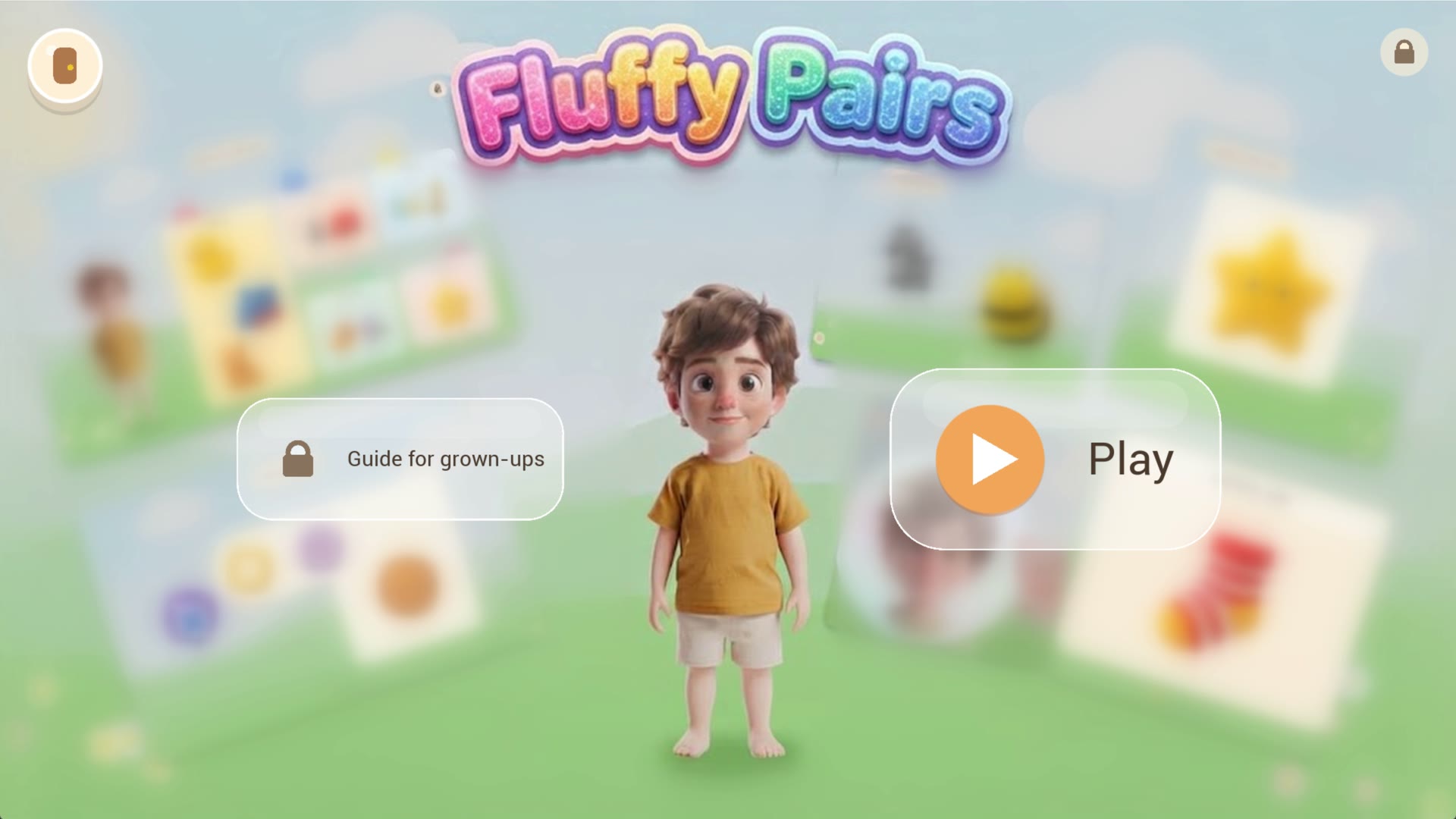
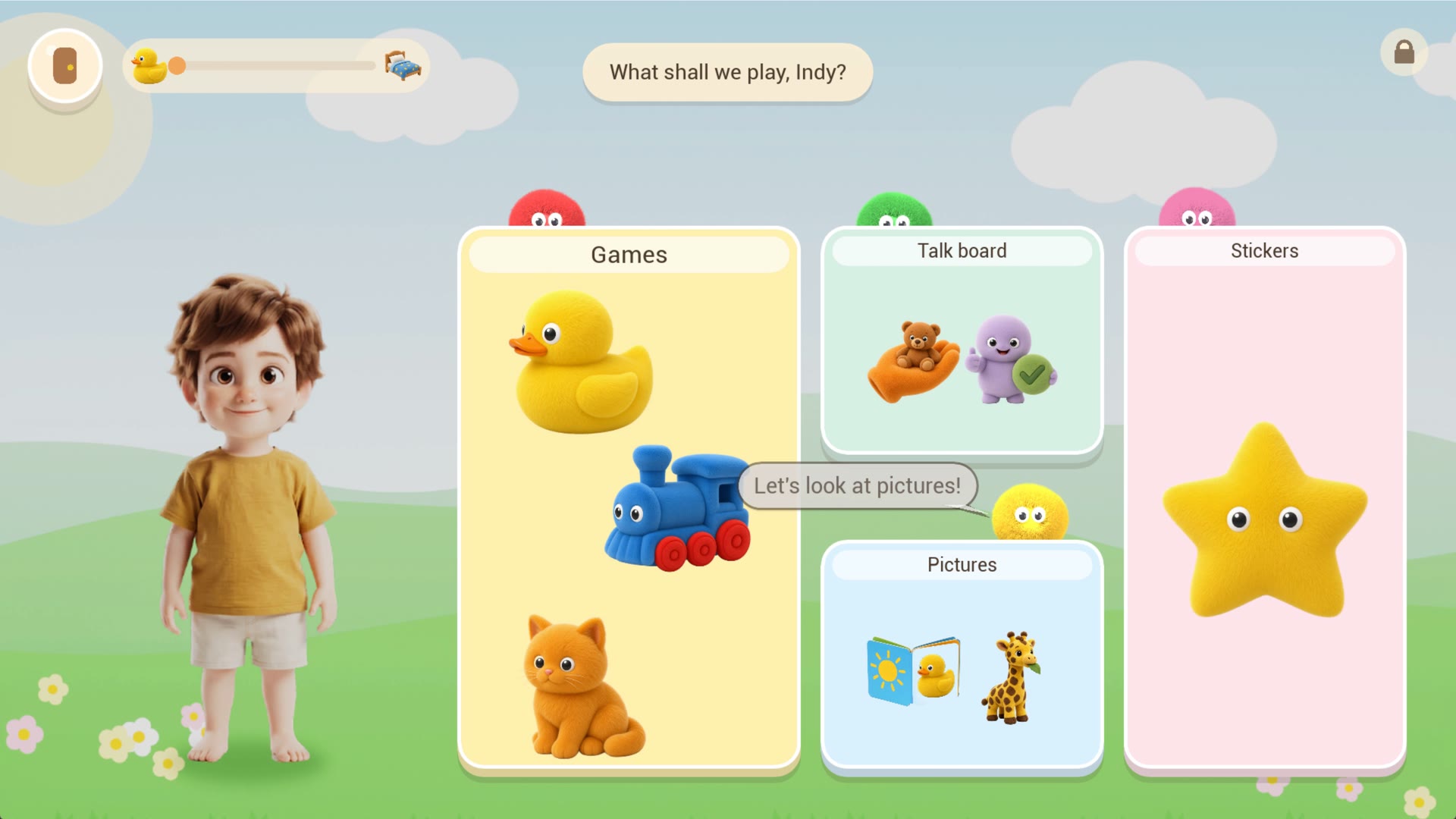
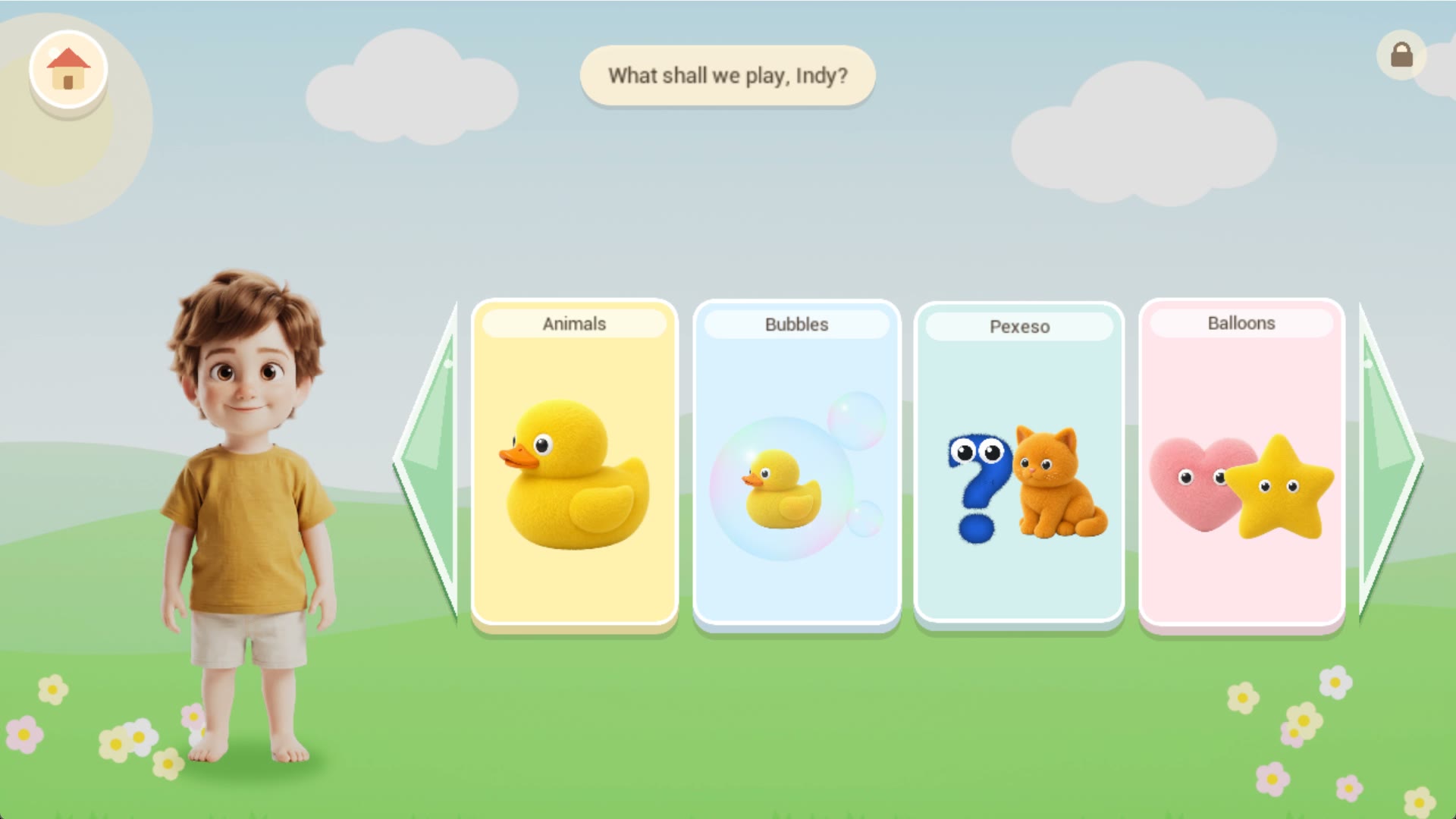
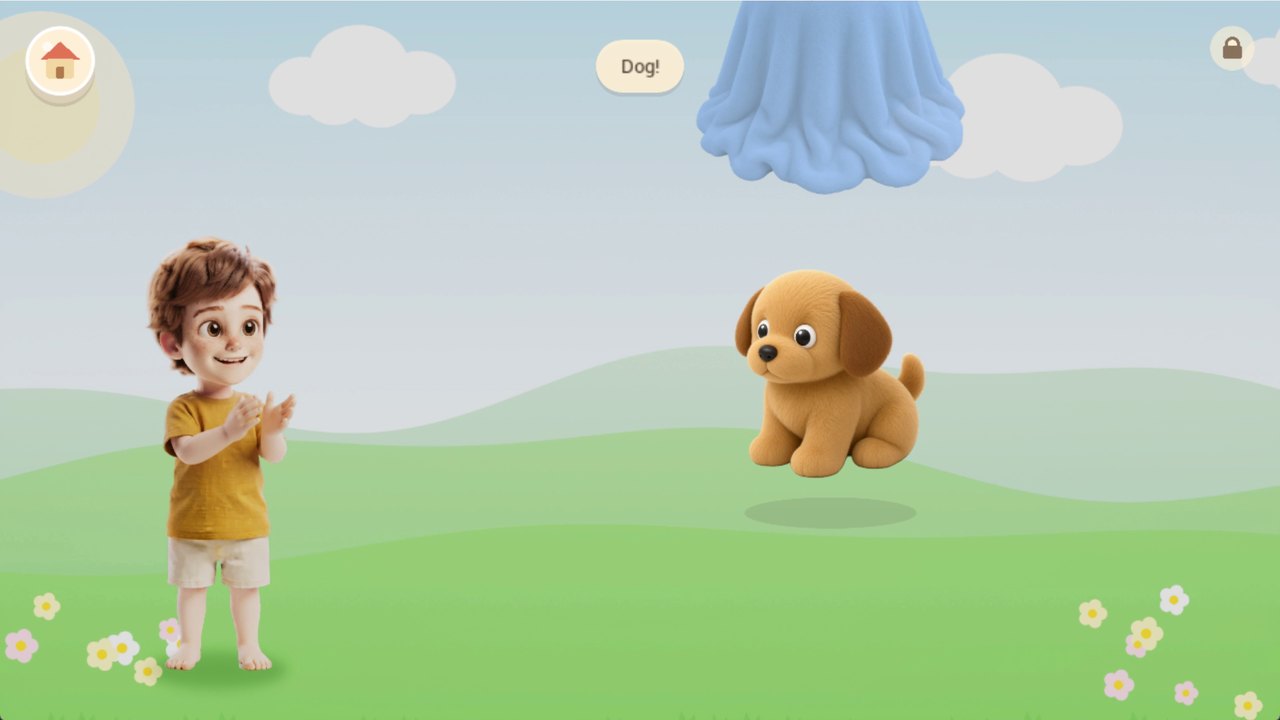
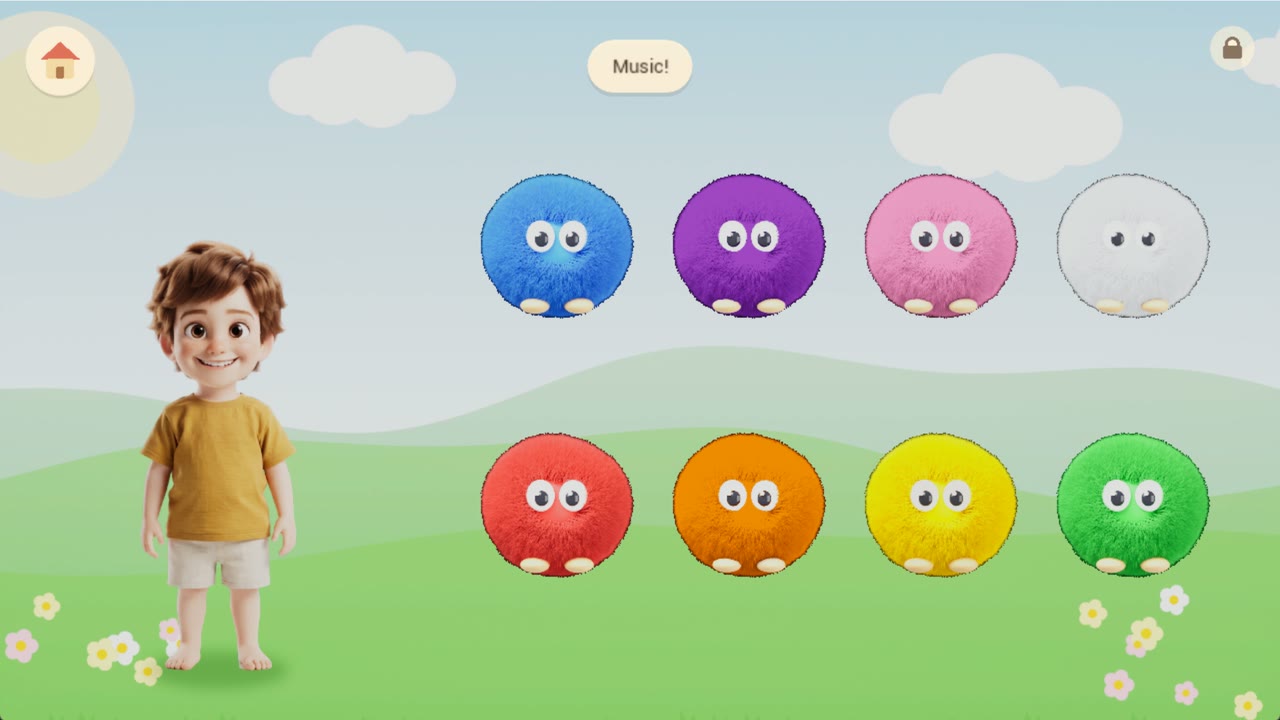
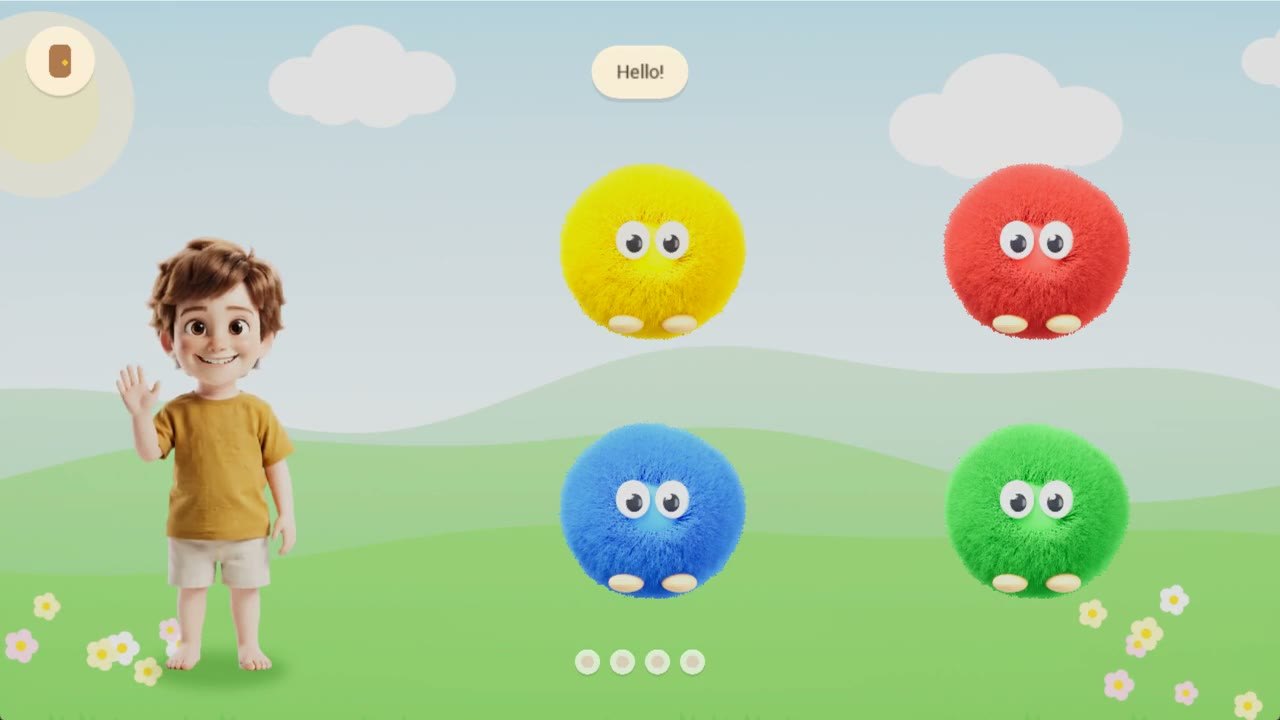
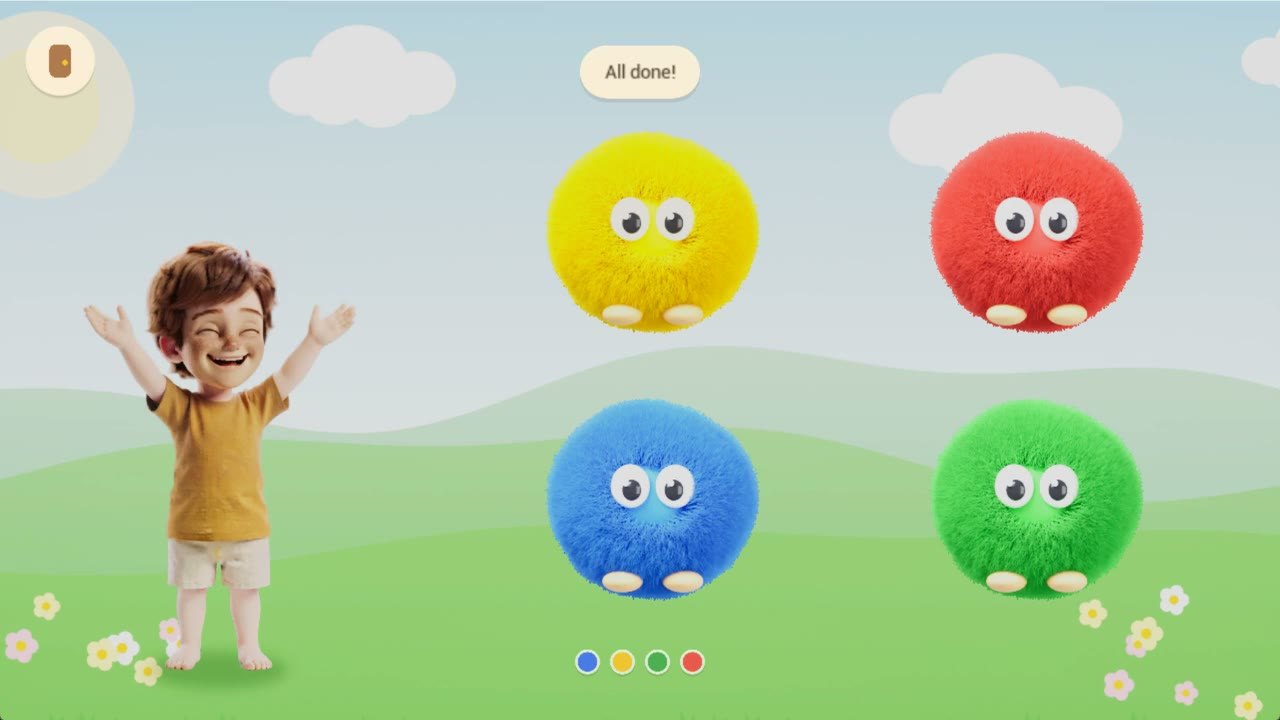
Indy is three. He has a speech delay. He loves letters, music and things that spin, and words are still on their way. Fluffy Pairs is a little app made just for him: Bobo, a friend who looks like Indy, walks onto a sunny meadow, waves hello and asks "What shall we play?" A cheerful start screen with big buttons, fluffies peeking over them and chatting in comic bubbles, leads to the games, the talk board, pictures and stickers. The games sit in one endless row of four big tiles that Indy can swipe or move with big glass arrows.
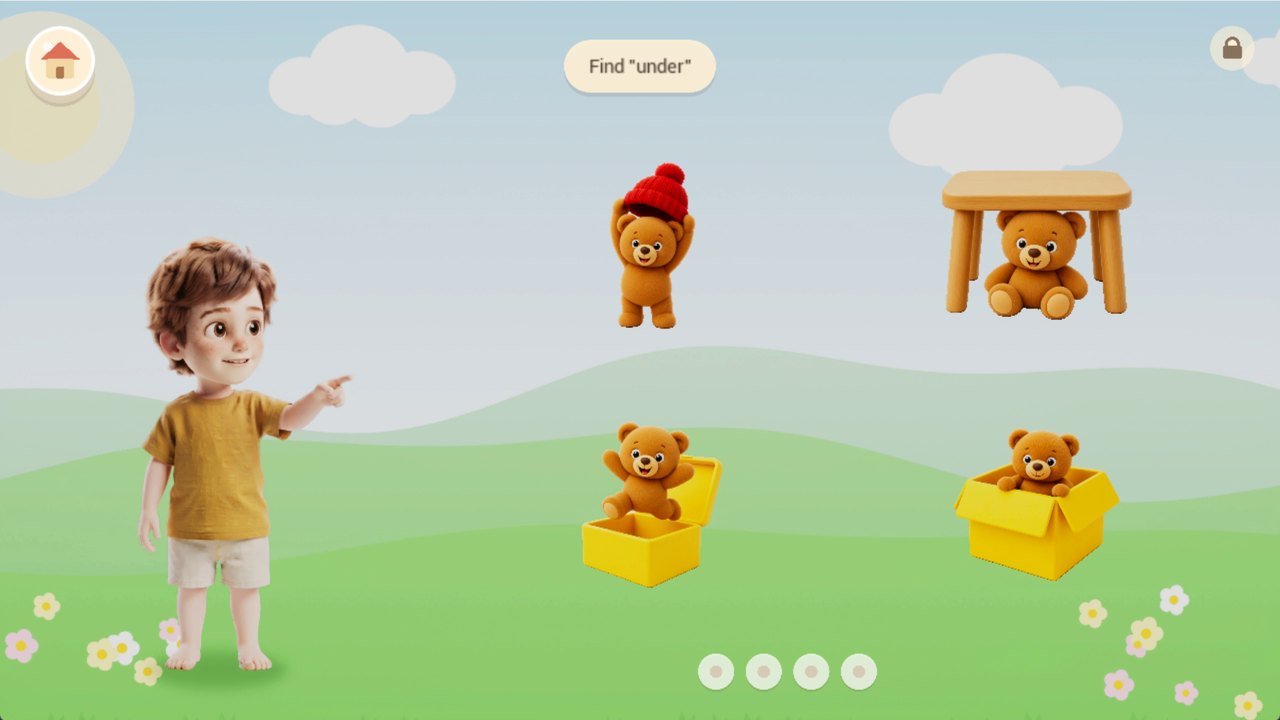
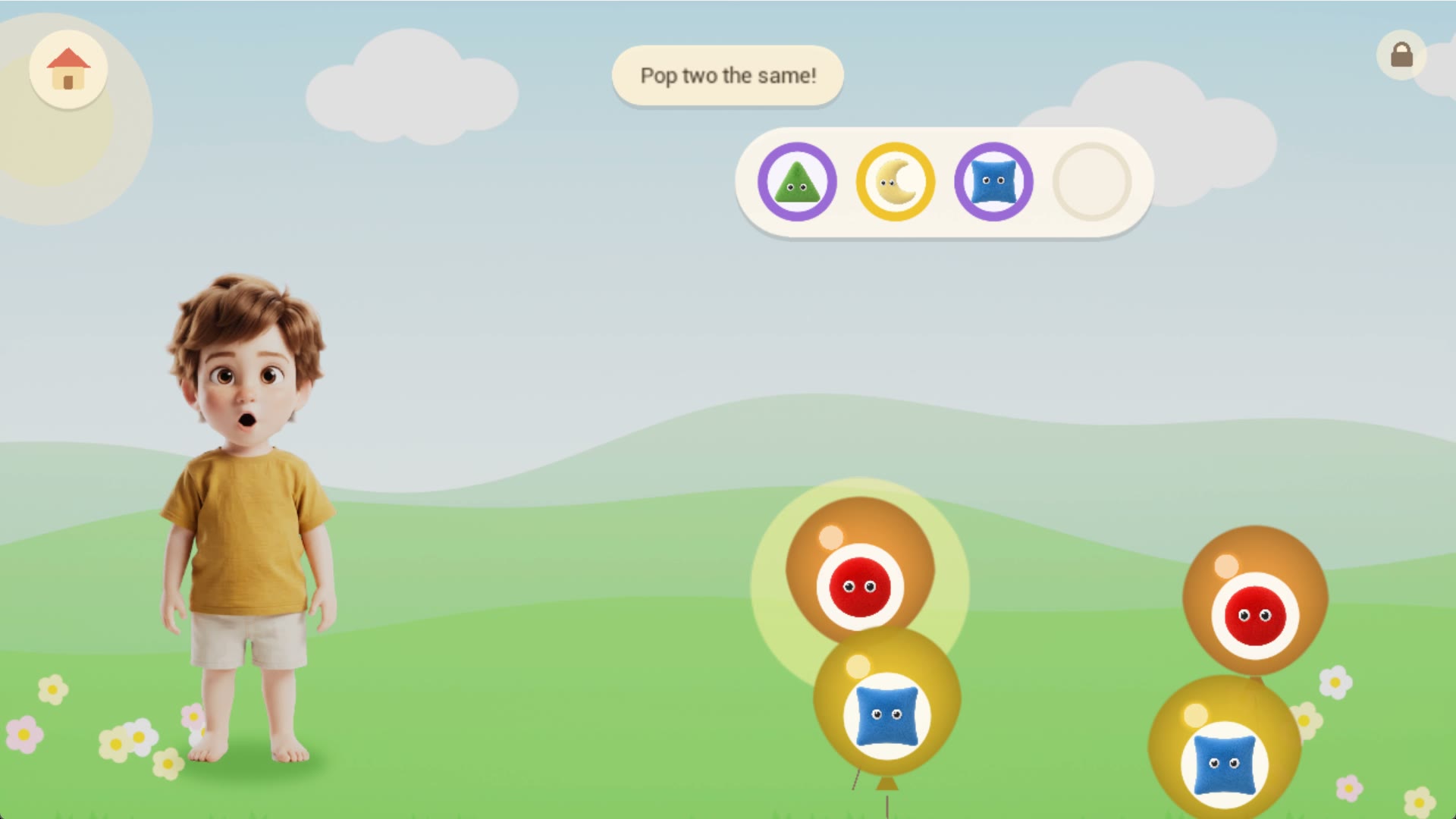
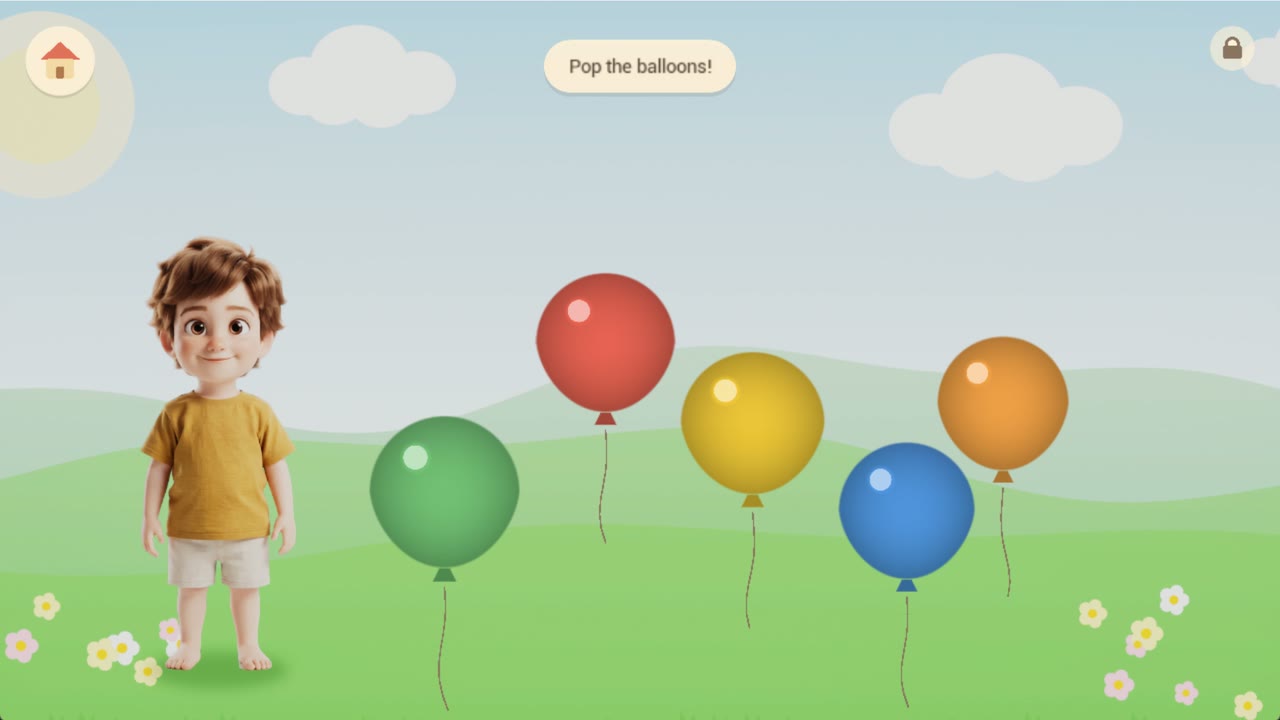
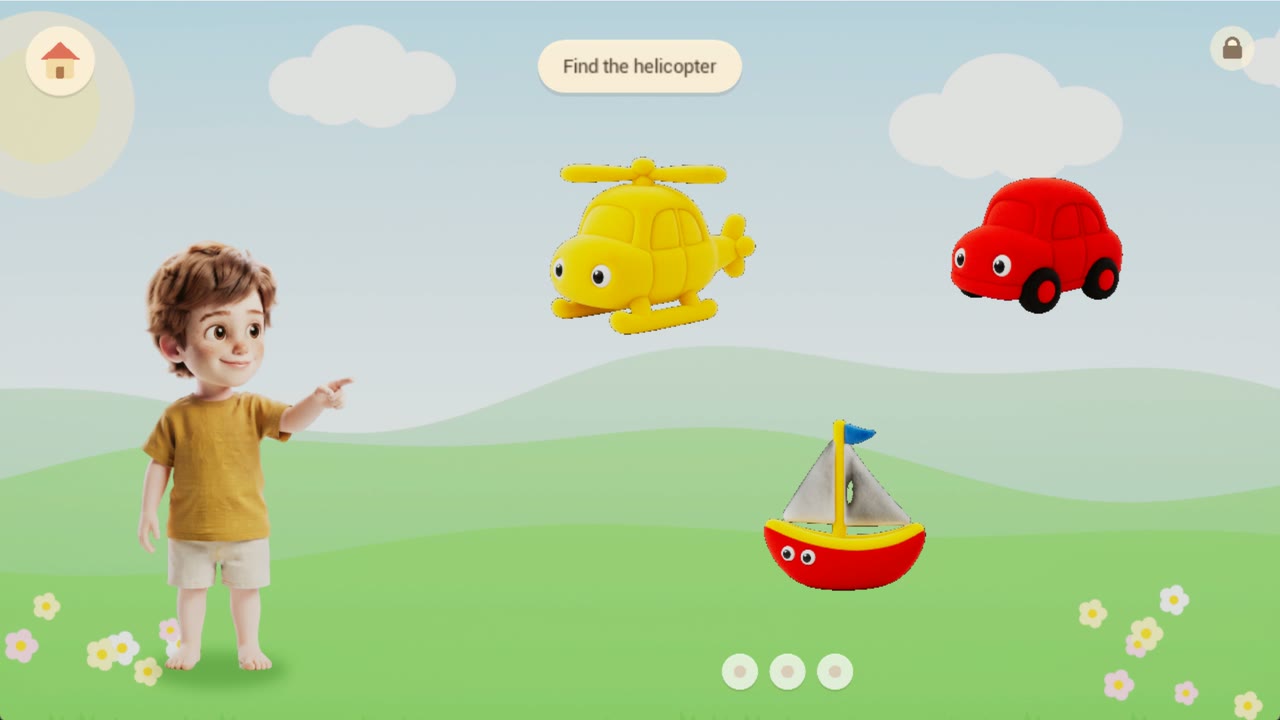
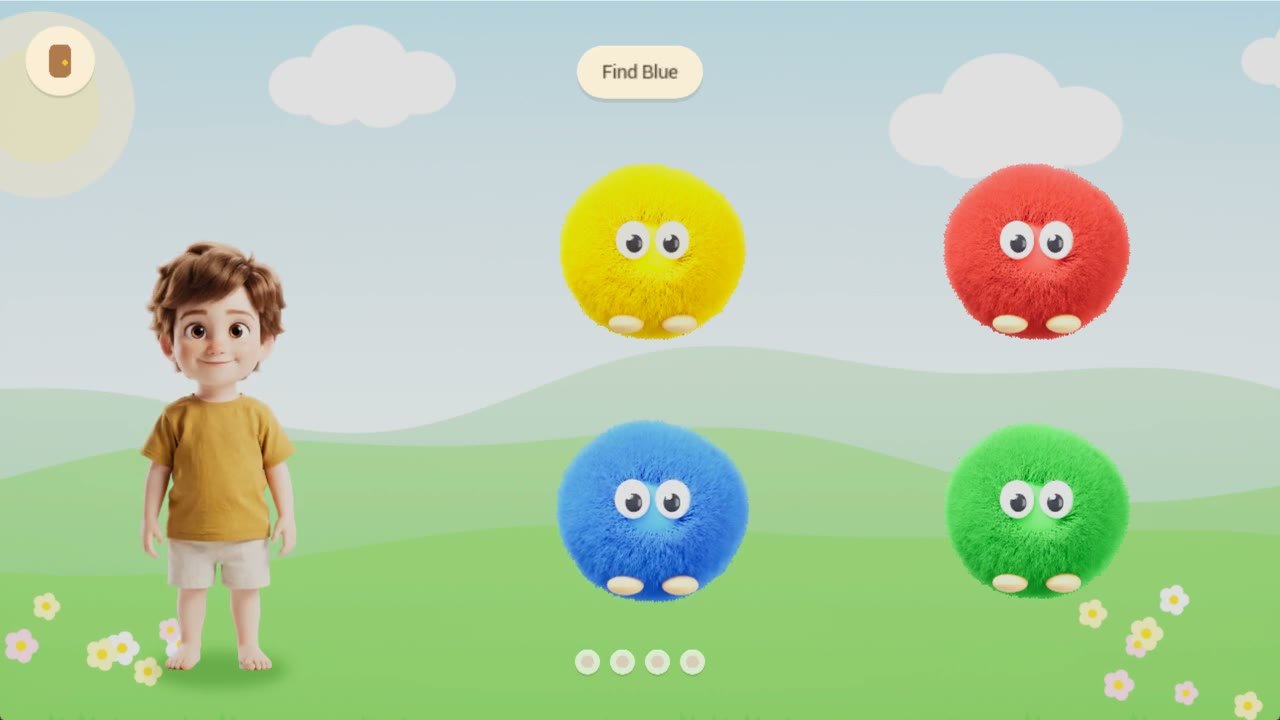
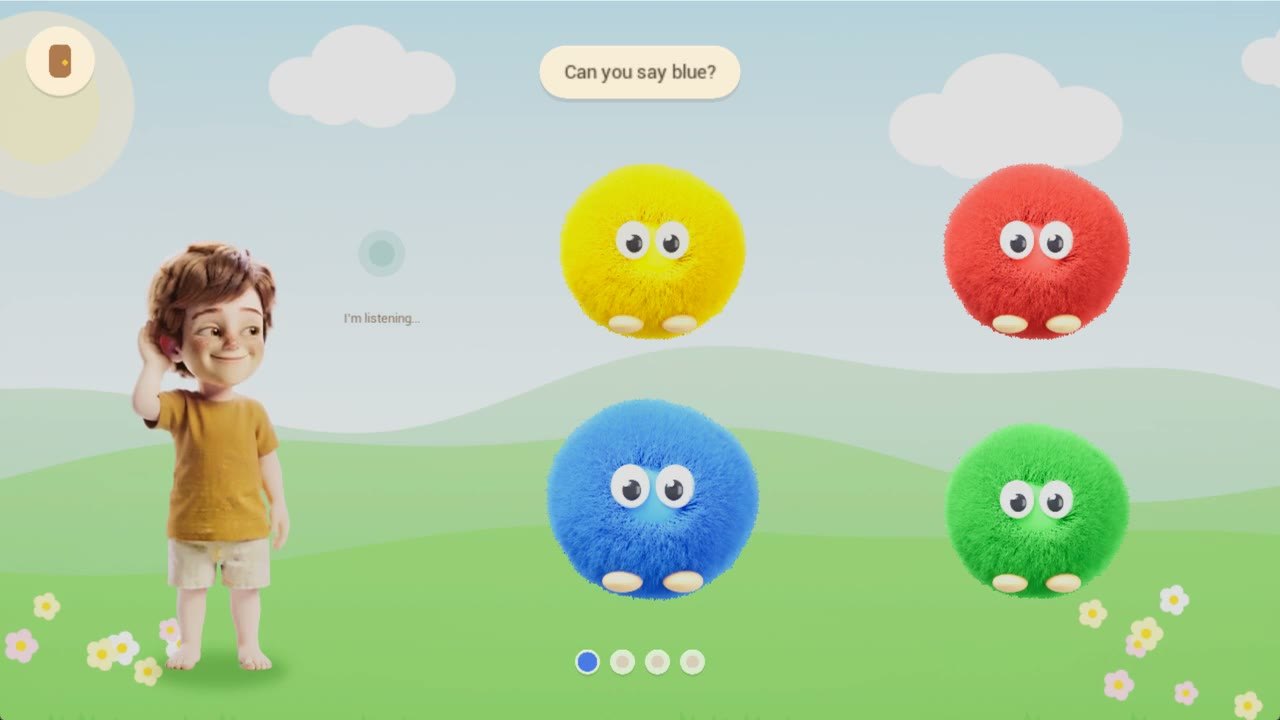
In the finding games Bobo asks for a duck, a red fluffy, a tractor or the number two. When Indy taps it, Bobo claps and says the word, then puts a hand to his ear and waits. Whatever Indy says, a word, a babble or nothing at all, is fine: Bobo plays his voice back and says the word once more. After every two rounds, balloons float up for Indy to pop, and Bobo counts them with him.
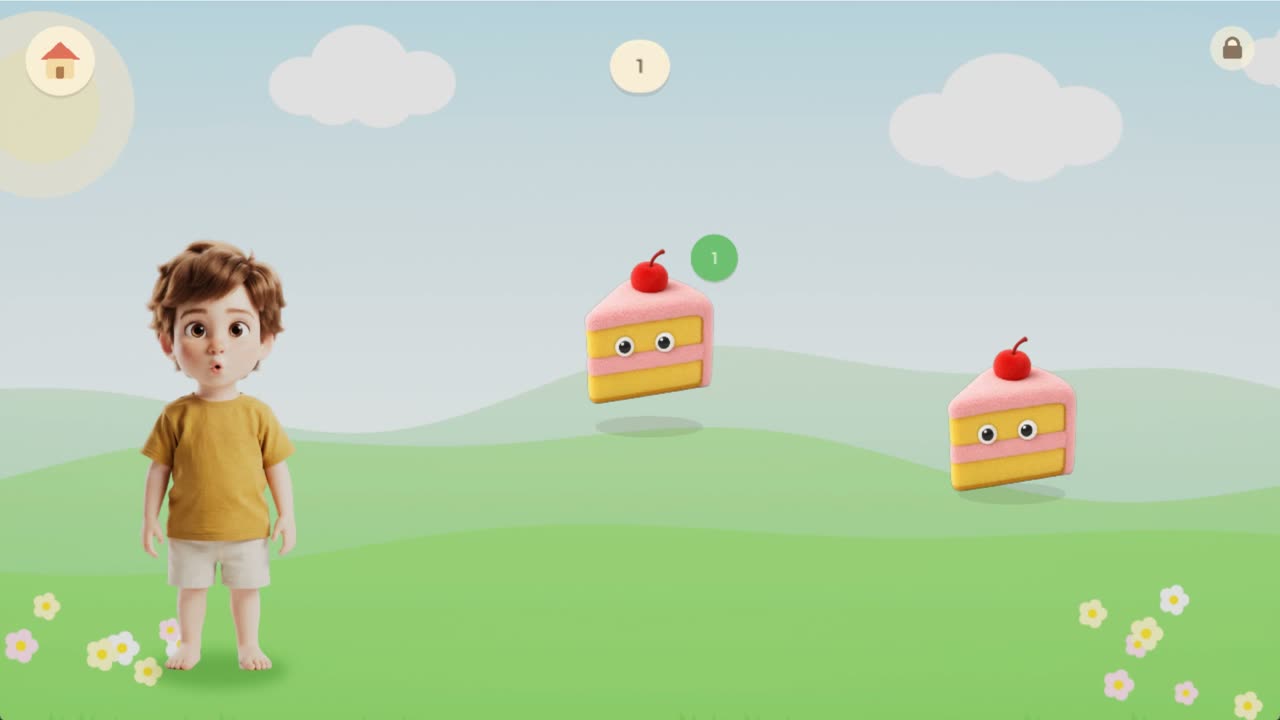
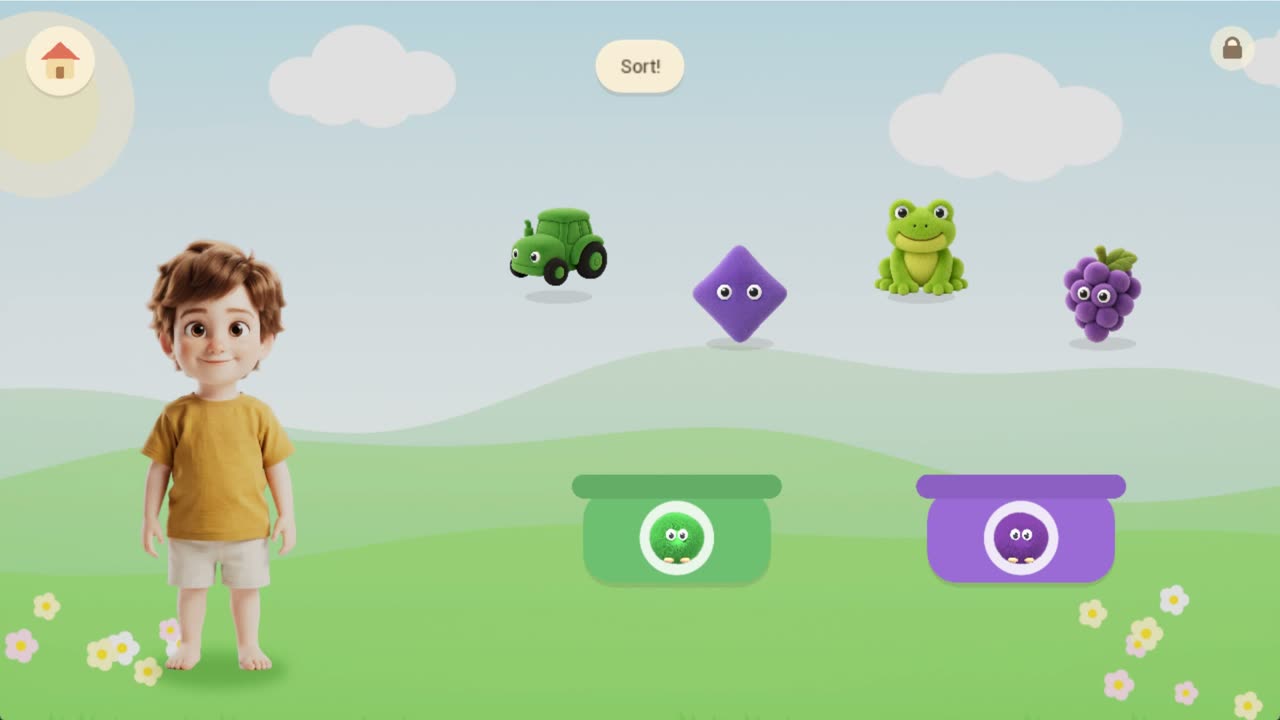
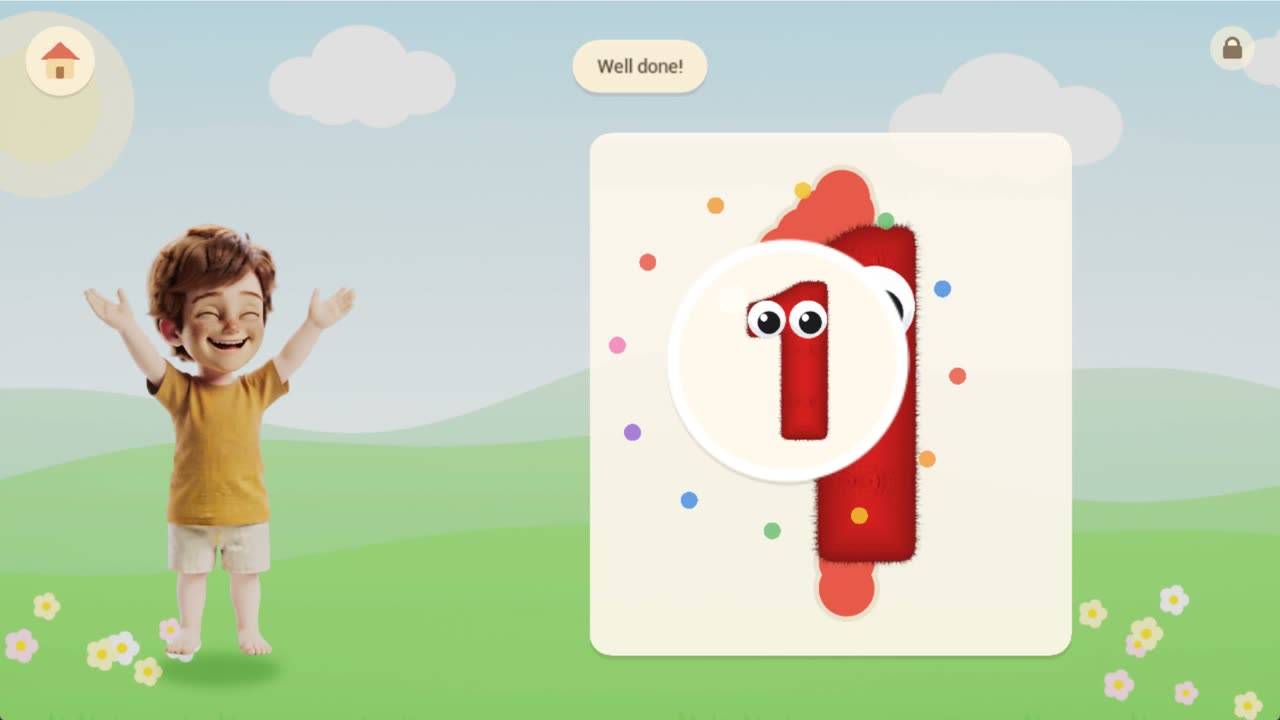
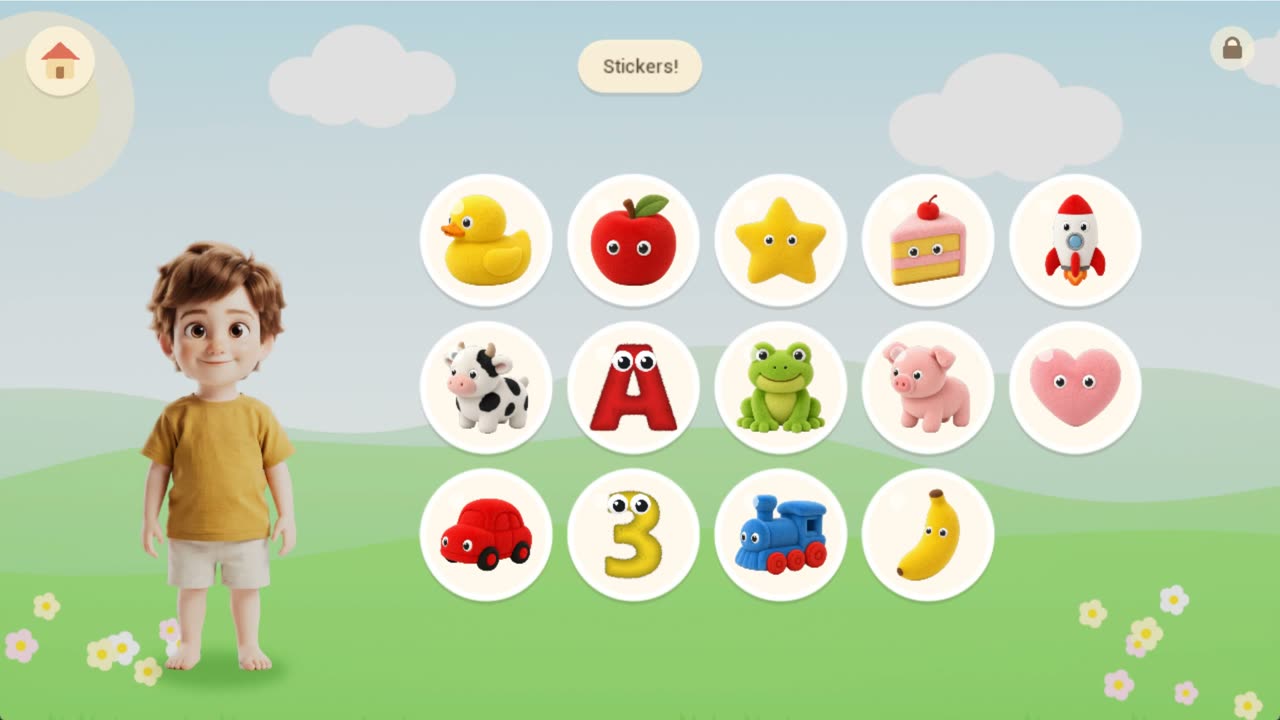
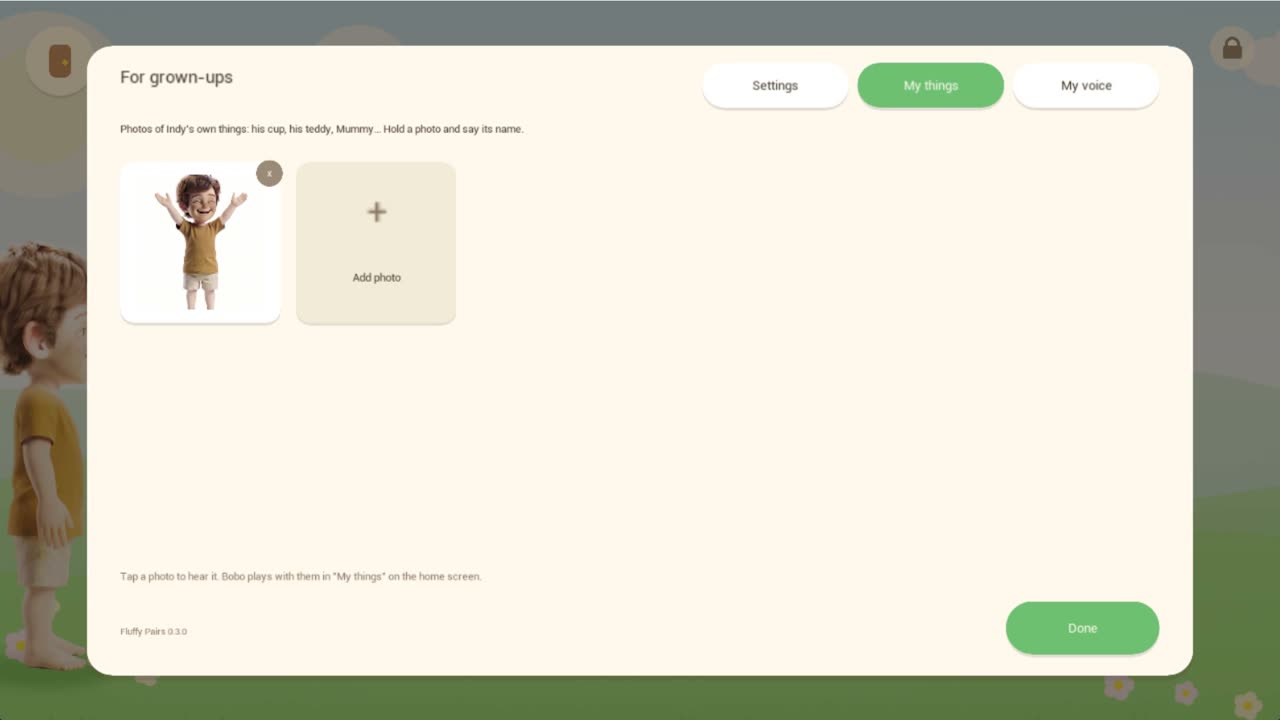
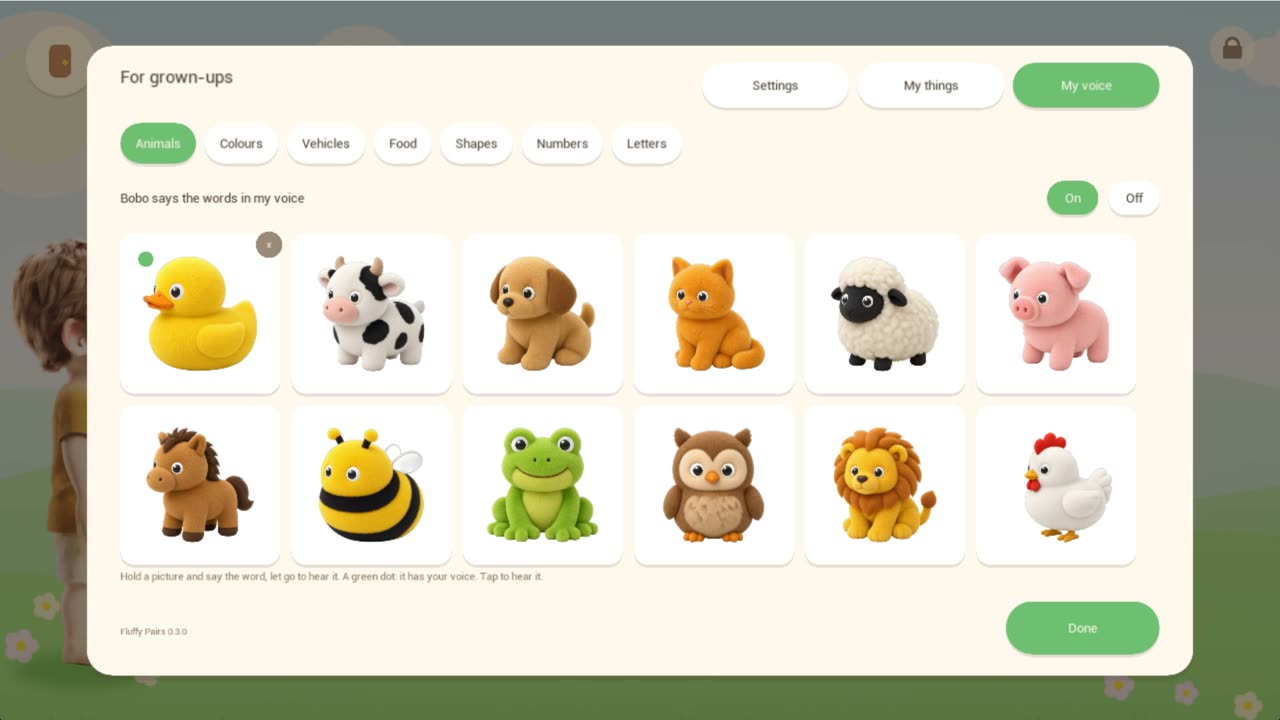
Version 0.3.0 adds hands-on play: counting cakes and ducks, sorting things into colour baskets and shapes into bowls, picture puzzles in two to four pieces, and drawing numbers and letters by following dots with a finger. In the balloon game, balloons with shapes, colours, numbers and letters float up: Indy pops two the same, or pops the one Bobo asks for, and each one lands in a little row at the top. Every finished game wins a sticker for his sticker book. A grown-up can add photos of real things from home, like his own red car or Mummy, and record words in their own voice, so Bobo asks "Can you find..." and then says the word just the way Mum or Dad does.
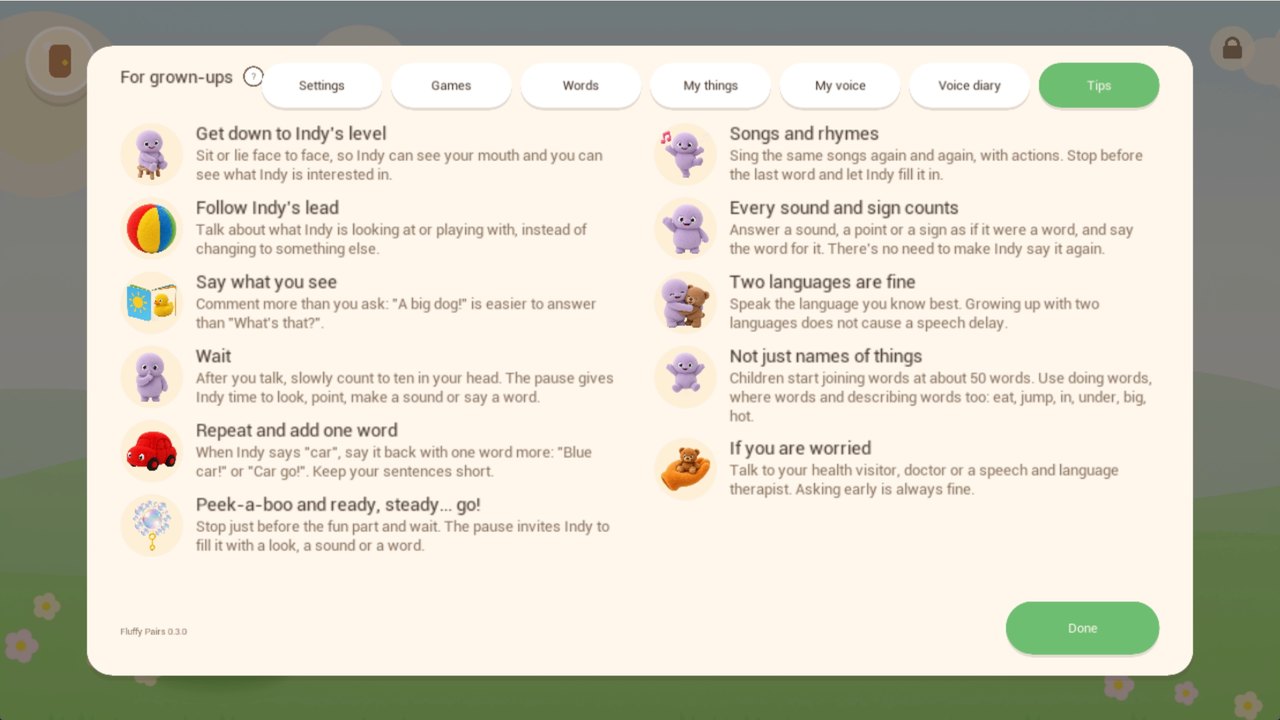
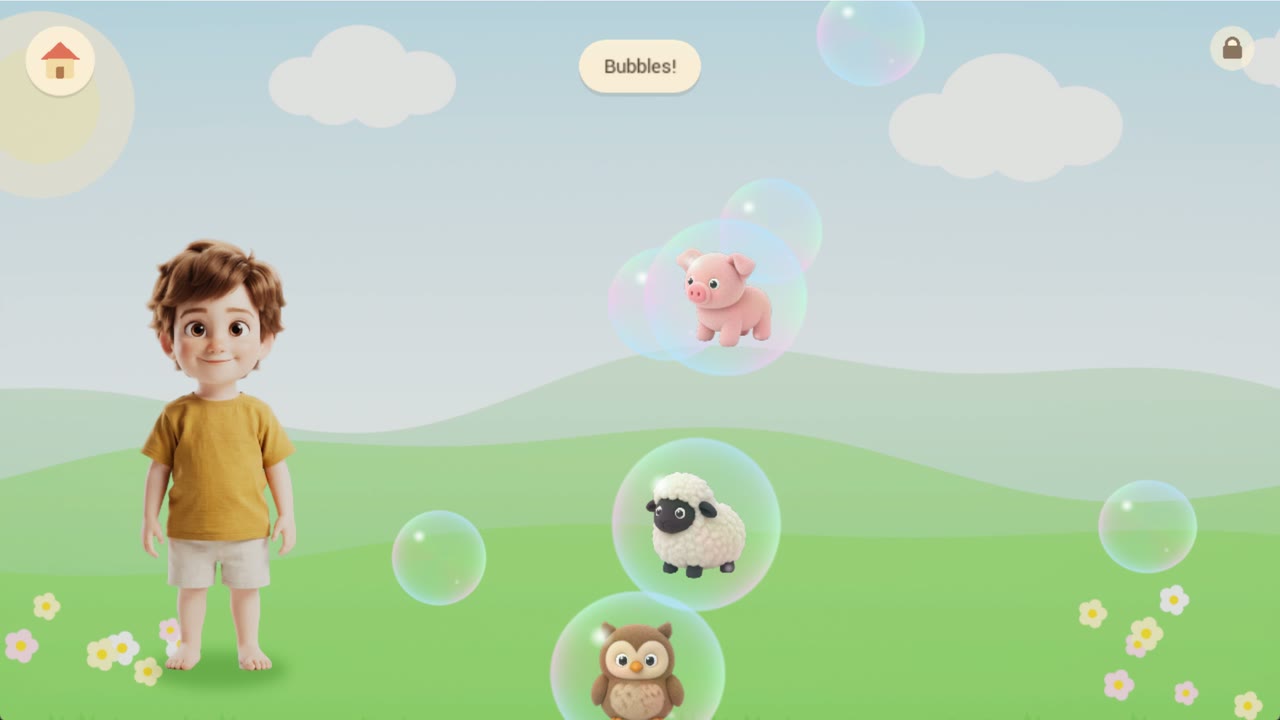
Version 0.3.1 brings a hundred more simple words, following the early-words advice speech therapists give parents. Children start joining words at about fifty, and for that they need more than names of things, so there are new worlds of doing words (eat, jump, push, sleep), where words (in, on, under, behind), describing words and feelings (big, hot, wet, happy, tired) and everyday things (cup, shoe, bath, bed), plus more animals, food and polite words like please and thank you. Every word comes in a short phrase with one word more: "Eat! Eat the apple!" There is a peek-a-boo game, the bubbles now wait for "Ready, steady... go!" so Indy can fill in the last word, and grown-ups get a Tips page with simple ways to help a child talk. Version 0.3.2 gives Bobo clearer, gentler mouth shapes for every sound, so his mouth is easy to watch. Version 0.4.0 follows a speech therapist's way of talking: Bobo simply says the word for Indy to hear instead of asking him to say it, and after the fun moments he pauses and asks "More?". There is a this-or-that choice, words of the week that Bobo uses most, and a goodbye card that shows a grown-up today's words, each with one word more to say at home. Version 0.4.1 comes from our first tests at home: when Indy finds a picture, Bobo says its name twice, waits, then makes its sound, and every popped bubble and every tap in the number train is named. Version 0.4.2 comes from our first tester: two new worlds, clothes (a T-shirt, a coat, boots, a hat) and my body (nose, ears, hands, feet), a switch that makes the games use only the words a grown-up picked, and Bobo now says both names when two memory cards are turned quickly. Version 0.4.3 adds a spinning wheel: Indy swipes it round, and whatever it stops on comes back as a sky full of bubbles to pop while Bobo claps along, a little lesson in waiting for a treat. Version 0.4.4 lets Bobo finish what he says: in peek-a-boo the other blankets wait until he has named what came out, and the talking face always says its word to the end. Version 0.4.5 makes the grown-ups' corner easy to use on a phone, and if no name is set, Bobo calls the child "my friend". Version 0.4.6 comes from a tester: the bus is now a yellow school bus and the helicopter is brown, so neither looks like the fire engine or the car, and the grown-ups' guide has a privacy page. It is also the first version sent to Google Play for a closed test.
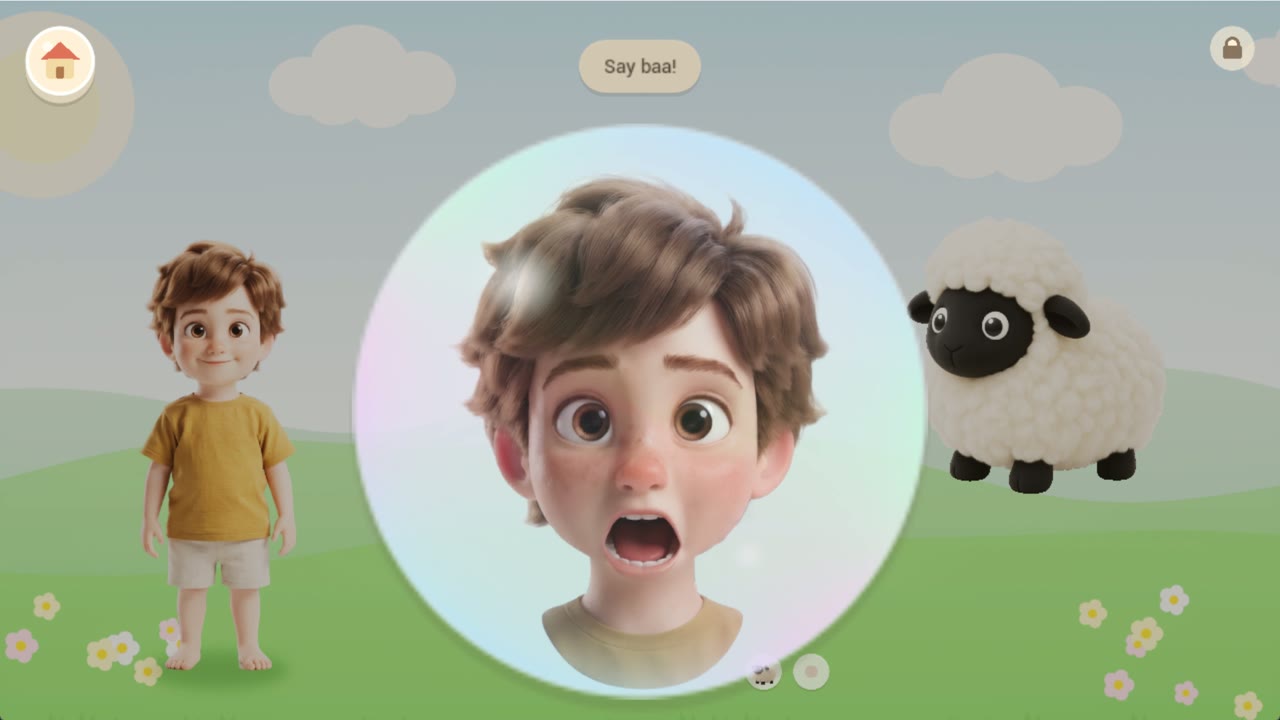
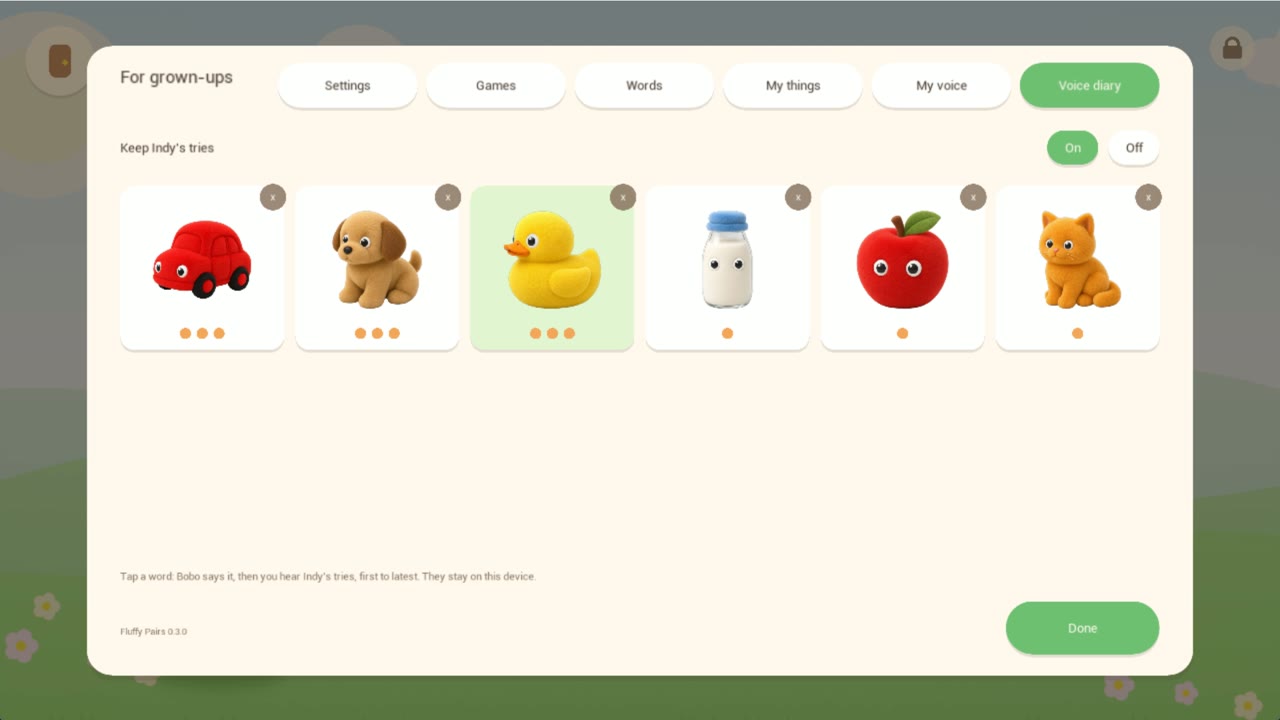
It also speaks Indy's home languages. Bobo can play in English, Czech, Spanish, French, German or Chinese, and in First words a big face in a soap bubble says each word slowly, with real mouth shapes, so Indy can watch how it is made. In a bilingual home the face can say it a second time in the other language, while Bobo keeps to the main one. Grown-ups get a voice diary with Indy's own tries at each word, so you can hear his words grow, and every setting has a little question mark that explains what it does.
- Nothing is ever wrong: no score, no timer, no buzzers. Tapping another fluffy just makes it hop and say its own name.
- Time to answer: Bobo waits up to ten seconds, the way speech therapists suggest, and never says "try again".
- His own voice back: the microphone plays back whatever the child said, and the fluffy puffs up while they talk.
- A friend who talks properly: Bobo's lips move with every word, with a clear, gentle mouth shape for each sound, so little ones can watch how words are made.
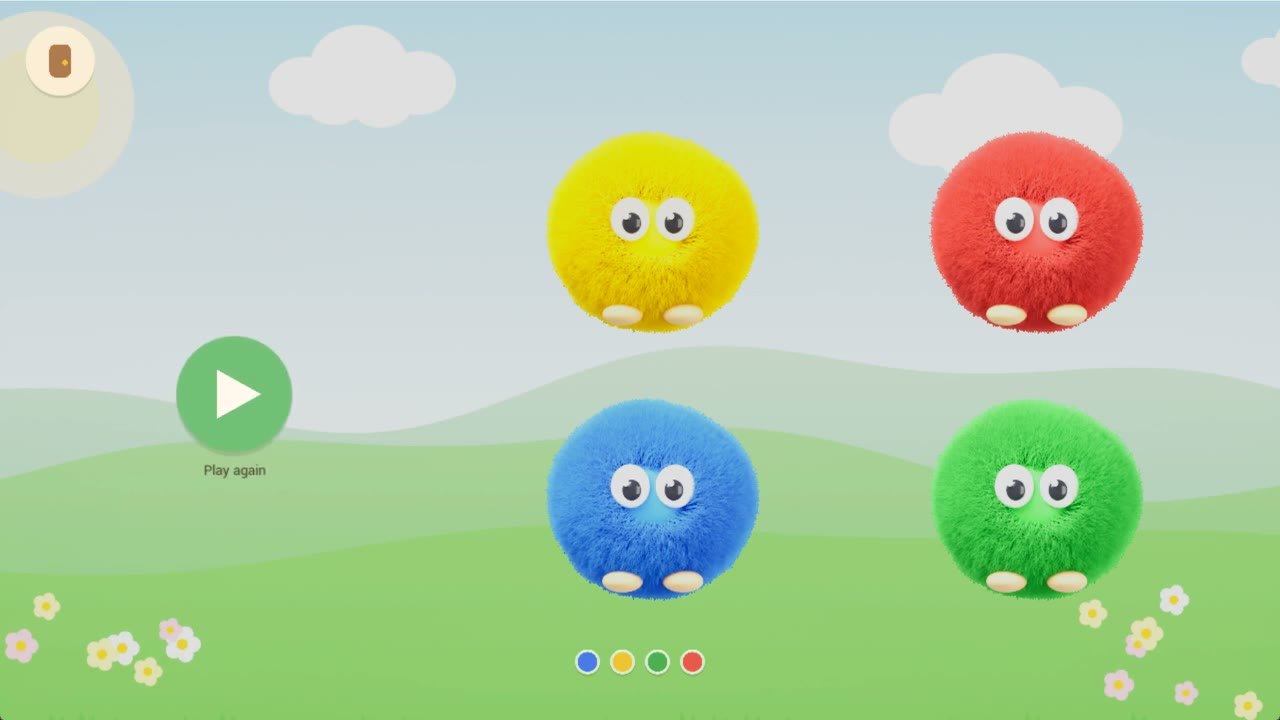
- The same every time: the same hello, the same goodbye wave. A play-again button and a little door to leave, both easy to find.
- Grows with the child: every game starts easy and gets a little harder only when the child is ready: one fluffy up to four, two memory pairs up to six.
- More than names: about 200 words: doing words, where words, describing words and feelings next to animals and food, because children need them to start joining words. Each comes in a short phrase with one word more.
- Peek-a-boo and ready, steady... go!: a peek-a-boo game, and bubbles that wait for "go!". The little pause before the fun part invites the child to say the word.
- Tips for grown-ups: simple ways to help your child talk in play and every day: get down to their level, wait, repeat and add one word, and when to ask for help.
- Hands-on play: counting, sorting by colour and shape, picture puzzles and drawing letters and numbers with a finger, each one starting easy.
- Balloon pairs: balloons float up slowly; pop two the same, or the one Bobo asks for. A tap on another balloon just pops it and Bobo says what was inside.
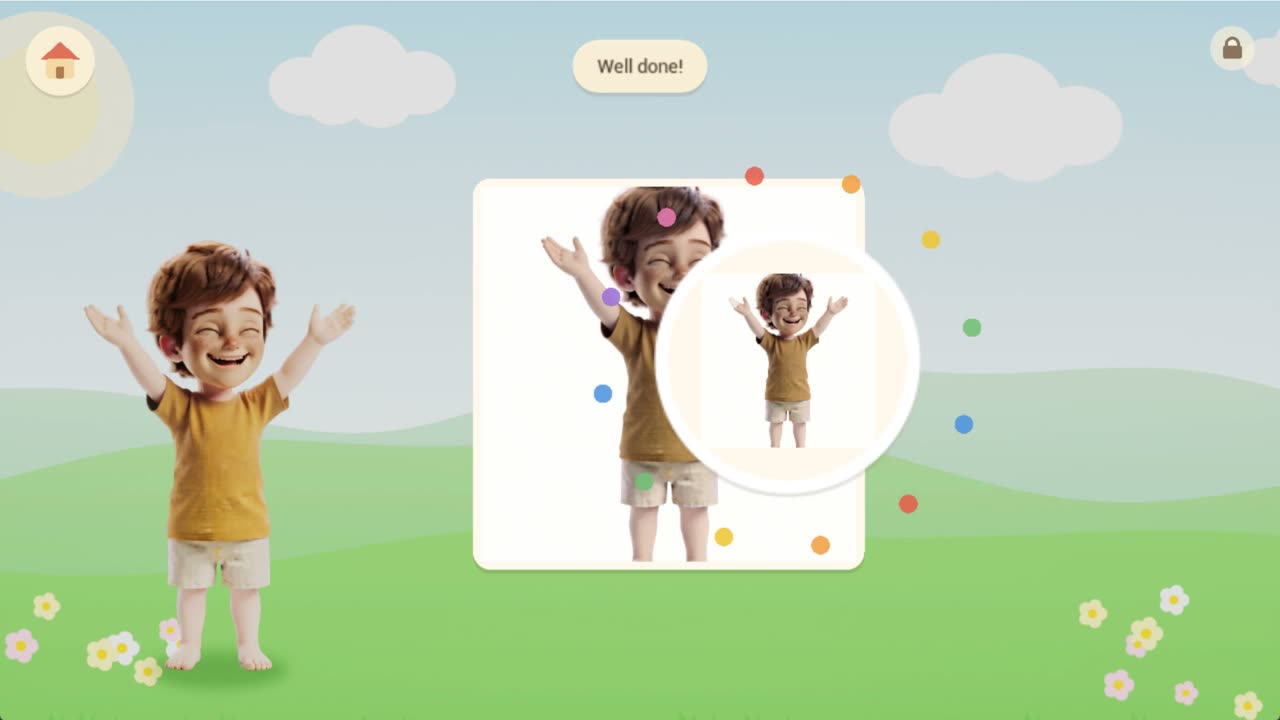
- Stickers to keep: every finished game wins a sticker, and the sticker book keeps them all.
- His own things, your own voice: add photos of real things from home and record words in your own voice. Bobo plays with them in "My things".
- Watch the mouth: a big face in a soap bubble says each word slowly, with real mouth shapes, then pops. A tap pops it straight away.
- Six languages: English, Czech, Spanish, French, German and Chinese, each downloaded only when you pick it. The talking face can add a second language for bilingual homes.
- Voice diary: the child's tries at each word are kept on the device, so you can hear the words grow. Switch it off any time.
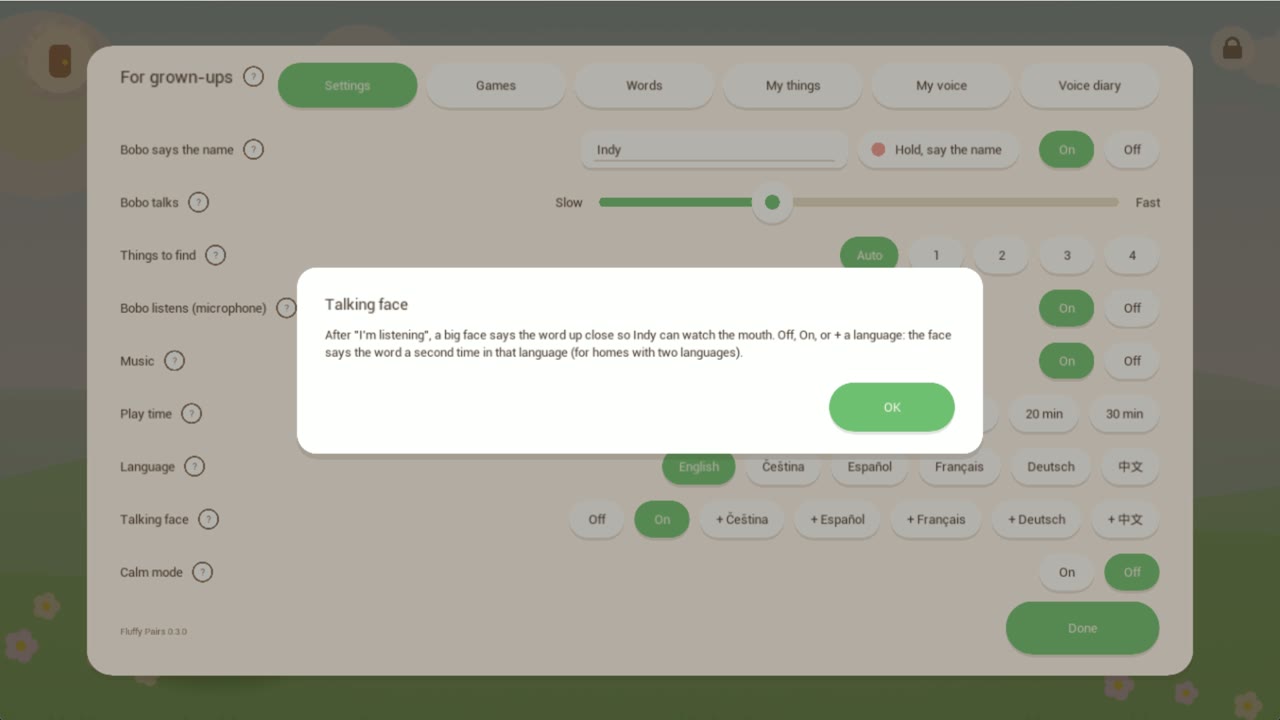
- A corner for grown-ups: hold the lock to set the child's name (recorded in your voice), the microphone, music, language, talking speed, a play-time limit with a calm goodbye, and a calm mode with softer sounds and no sliding or bouncing. Every setting has a ? that explains it.
- Your order, your numbers: grown-ups can put the favourite games first, hide the rest, and switch on numbers on the tiles to say "number 7".
- Photos made simple: a new photo is cut out from its background automatically, and you pick the cut-out or the whole photo.
- Phone or tablet: Android phones and tablets and Amazon Fire tablets, with big buttons made for small fingers.
Why we made it, and why we share it
Like many parents of a child with a speech delay, we spent a long time looking for something on the tablet that would really help Indy, not just keep him busy. Most apps we found were loud and fast, with scores, timers, buzzers for wrong answers, adverts and things to buy. For Indy that was too much. So we made our own: Bobo says each word slowly and then waits, as speech therapists suggest, and whatever comes back, a word, a sound or nothing at all, is fine.
We built it for Indy, but we know we are not the only family on this road. If your child is late to talk, we hope Bobo can be a gentle helper for you too. Fluffy Pairs is free, with no adverts and nothing to buy, and nothing your child says ever leaves the device. It is not a therapy and does not replace a speech therapist: it is a calm place to play and practise words together.
Read it or share it in: English · Čeština · Español · Français · Deutsch · 中文
How far we are
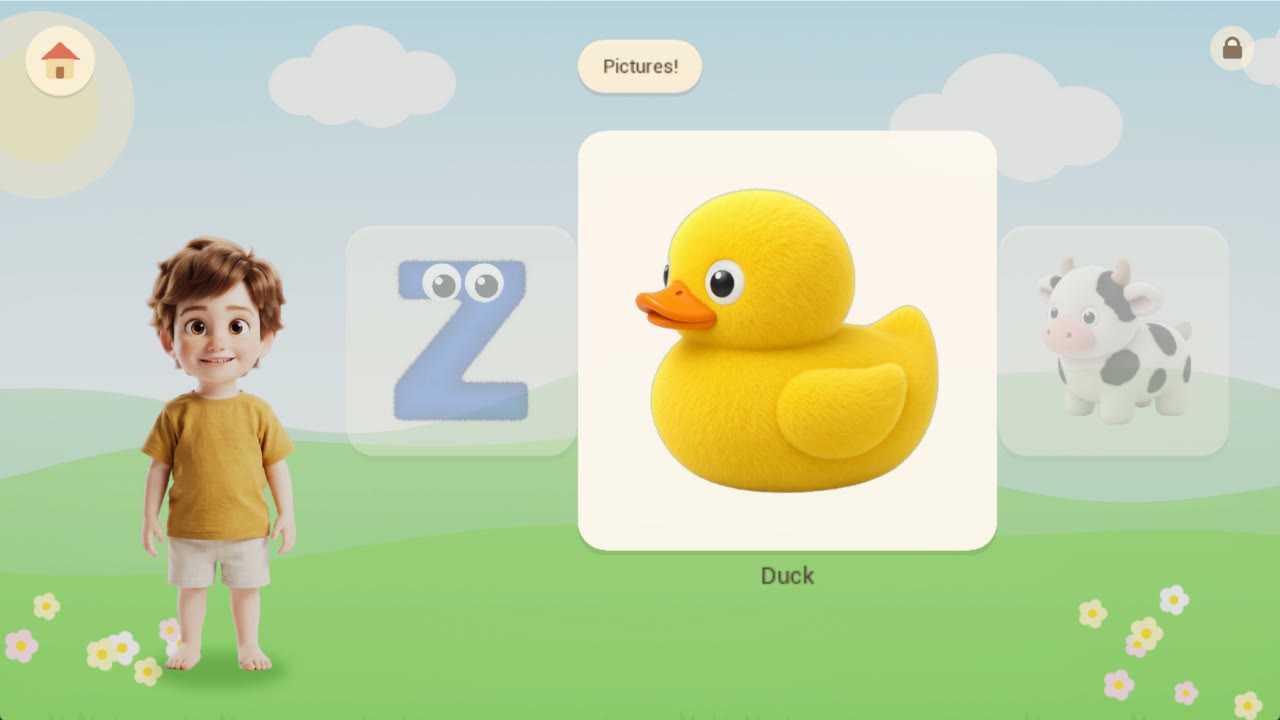
Google asked for 14 more days of testing before Fluffy Pairs can go public (5 November 2026), so the closed test is open again. Testers who play it now and then and tell us what they think really help. Google approved the first closed test of version 0.4.6 on 15 October 2026. It's rated PEGI 3 and made for ages 5 and under. Google needs at least 12 testers to keep it installed for 14 days before it can go public, so every tester really helps. Version 0.4.6 also follows a tester's note: the bus is a yellow school bus and the helicopter is brown, so neither looks like the fire engine or the car, and the grown-ups' guide has a privacy page. Version 0.4.5 is for phones. The corner for grown-ups used to squeeze everything onto one screen, far too small on a phone: now it fills the screen, opens on big buttons for each part, and long pages turn like a book. If grown-ups haven't set the child's name, Bobo says "Hello, my friend!" instead of leaving it out, in every language. Version 0.4.4 follows more notes from home. In peek-a-boo, a quick child used to lift every blanket at once and hear only the last name: now the other blankets stay down until Bobo has said what came out. The talking face can't be tapped away any more, so Indy always sees and hears the word up close, both times. Bobo listens for five seconds instead of seven, and once he hears a voice he answers within two seconds, even in a noisy room. Grown-ups who recorded the child's name can delete the recording again with the x on its button. Version 0.4.3 adds a spinning wheel game. The wheel has a picture from every world on it (an animal, a letter, a number, a toy...), Indy swipes it round with his finger, and it slowly clicks to a stop. Then the wheel disappears and what it stopped on comes up as lots of bubbles: eight the first time and a few more every round, up to twenty, and they stay until every one is popped, while Bobo claps along. When Indy finds a picture, Bobo now says its name once and makes its sound, and the talking face says it twice up close: the first time just to listen, the second time Indy can pop it. With "only these words" on, bubbles, balloons, peek-a-boo, counting and the wheel use just the picked words too, and picking the first word of the week switches it on. Version 0.4.2 follows our first tester's notes. There are two new worlds to find, clothes and my body, and grown-ups can switch the games to "only these words": just the words of the week they picked, for example the few words a therapist is working on. Bobo says both names when two memory cards are turned quickly, and the tips for grown-ups are bigger and easier to read. Counting picks a different number each round, a picture now covers its shadow completely, the car is blue, the elephant says "pawoo", the monkey "oo-oo-aa-aa", the cow has a longer moo, and Bobo says the letters A, H, M, P and U clearly. Version 0.4.1 comes from testing at home with Indy. When he finds a picture, it grows and Bobo says the name twice, waits, then makes its sound and invites him to have a go. Counting ends with the whole answer ("Three cows!"), every popped bubble and every number tapped in the number train is named, the balloon treat comes after every third round, the pictures act out their sounds, and a few pictures are clearer. Version 0.4.0 makes Bobo talk the way speech therapists suggest. He doesn't ask "Say carrot" any more: he says the word for Indy to hear, waits, and is happy with whatever comes. After the fun moments he pauses and asks "More?", in some games Indy picks this or that, grown-ups can choose words of the week that Bobo uses most, and the goodbye card shows today's words, each with one word more to try at home ("Big ball!"). The sing-along songs are gone for now: Bobo's singing didn't sound good enough. Bobo now waits a few seconds before he hints, and for beginners he says just the word ("Ball.") until the child says 15 words. Grown-ups get a small tip at the start of each game, a picture schedule shows how far through today's play Bobo is, there is a daily screen-time limit (an hour on new installs), and music is off at first, with Bobo's voice, the sound effects and the music each on their own volume. A welcome screen helps grown-ups set the name, language and play time on the first start, the microphone ignores a noisy room better, girls' names fit everywhere, every game tile has its own picture, the row of games turns like a drum, the app opens with a title picture, grown-ups get a guide with pictures in all six languages, the door on the start screen no longer closes the app by accident (a tap makes Bobo wave bye bye, holding it for three seconds closes the app), and the app is much smaller to download: about 110 MB, and 15 MB for each extra language. Version 0.3.2 gave Bobo clearer, gentler mouth shapes, and 0.3.1 a hundred more simple words, a peek-a-boo game and a Tips page for grown-ups.
Done
- Bobo, drawn from Indy: he walks in, waves, points, claps, hops, cheers and waves goodbye
- His own British cartoon voice, with lips that move with the words
- Colour Meadow: "Find red", then a calm "Can you say red?"
- The microphone listens and plays back whatever the child says
- Play again after the goodbye, and a door to leave
- First test with Indy on his tablet
- Starts with one fluffy and adds one after each round he gets right (up to four), and the tablet remembers
- The right fluffy hops and the others step back, and a tap on the grass makes it hop too
- A home screen of big picture buttons that Indy can swipe left and right
- Seven worlds to find: animals, colours, things that go, food, shapes, numbers and letters, with 89 pictures
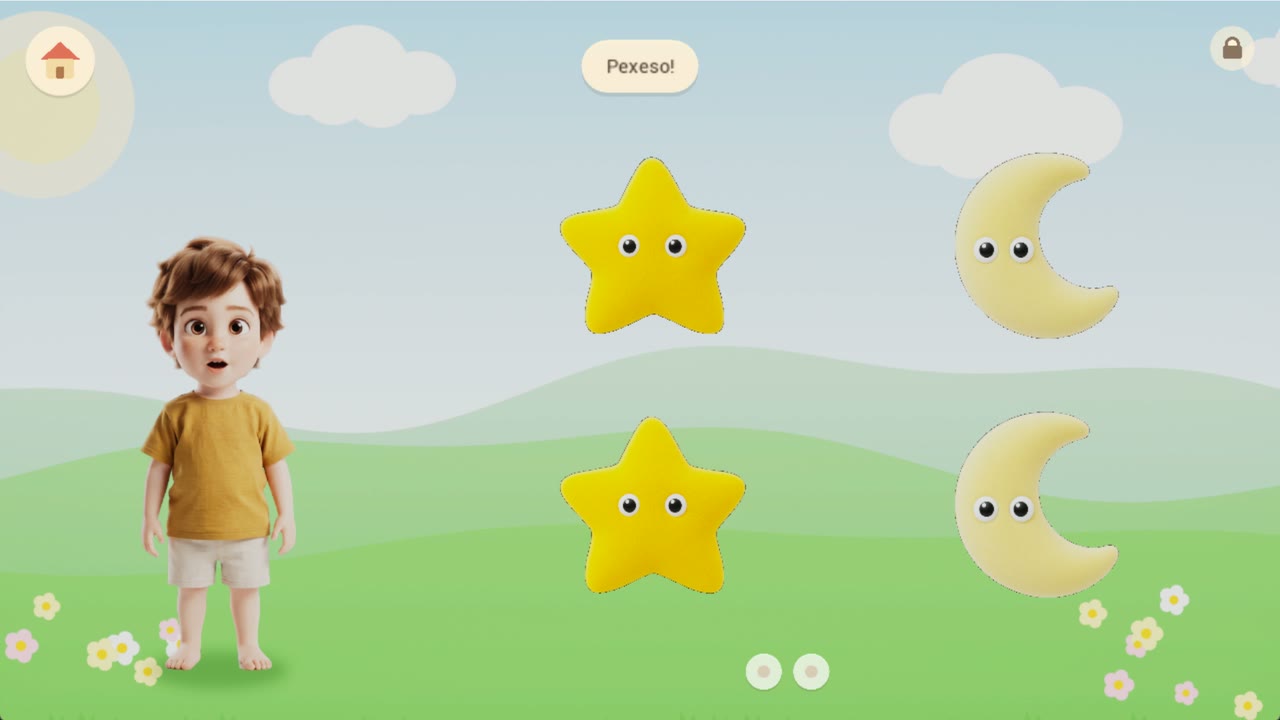
- Pexeso, the picture memory game: look at the cards, they turn over, find the two the same
- Balloons to pop after every two rounds, with Bobo counting from one to ten
- Bubbles with surprises inside, a xylophone with eight fluffy notes, and a picture book to swipe through
- Bobo says "Well done, Indy!", plus soft background music that goes quiet when Bobo talks
- A corner for grown-ups: name, microphone, music and a play-time limit
- Bobo talks slowly and models each word, with a slow-to-fast slider for grown-ups
- Counting, sorting colours and shapes, picture puzzles and drawing letters and numbers with a finger
- A balloon game: pop two the same, or pop the shape, colour, number or letter Bobo asks for
- Stickers for every finished game, and a sticker book
- Photos of real things from home, played with in "My things"
- Record your voice: Bobo says the words the way Mum or Dad does
- Six languages, downloaded when picked: English, Czech, Spanish, French, German and Chinese
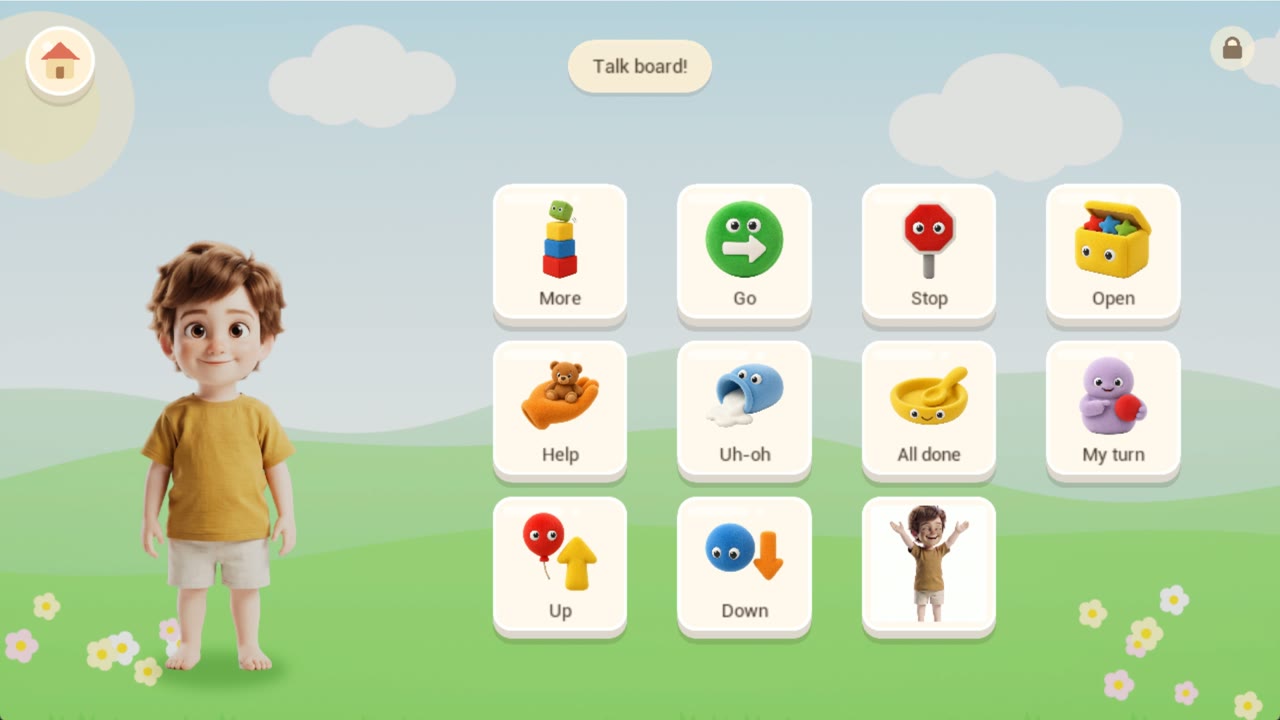
- First words like more, stop, help and all done, with a talking face that shows the mouth
- Bobo says the child's name in a grown-up's own recorded voice
- Lots of ways to say well done, not the same cheer every time
- A voice diary of the child's tries, big candy buttons that Bobo names out loud, and a ? next to every grown-up setting
- A funny start screen with fluffies peeking and chatting, and an endless row of four big game tiles with glass arrows
- Grown-ups can reorder the games and switch on numbers; photos are cut out automatically, or kept whole
- A hundred more words in four new worlds: doing words, where words, describing words and feelings, everyday things
- A peek-a-boo game, and bubbles that wait for "Ready, steady... go!"
- A Tips page for grown-ups, and a bigger talk board
- Clearer, gentler mouth shapes for Bobo, one for every sound
- Bobo models words instead of asking "Say...", and asks "More?" after the fun parts
- This or that, words of the week, and a goodbye card with today's words and one word more
- A welcome screen for grown-ups, a "noisy room" microphone setting and a smaller download
- Just the word for beginners, a longer wait before hints, and tips for grown-ups in every game
- A picture schedule, a daily screen-time limit, music off at first and separate volumes
- A title screen, a guide with pictures for grown-ups, and a door that can't close the app by accident
- After testing at home: Bobo says each found picture's name twice, then its sound, and counting ends with the whole answer
- From our first tester: clothes and my body worlds, both names in pexeso, new numbers each counting round and clearer animal sounds and letters
- "Only these words": the games use just the words a grown-up picked, and bigger tips for grown-ups
- A spinning wheel to swipe, with a shower of bubbles to pop as the prize for waiting
- Approved by Google Play for a closed test, in six languages, rated PEGI 3
- 12 testers kept it for 14 days, and we applied to open it to everyone (3 November 2026)
Next on the plate
- 14 more days of testing, with updates from tester feedback
- Opening it to everyone on Google Play
- Indy plays the new version: which games does he come back to?
- A native speaker checks each language
- A look from Indy's speech therapist
What you need
Android
- Android phone or tablet, Android 10 or newer (64-bit)
- About 200 MB free space
- Microphone, so Bobo can hear
- A Google account to join the Play test
Amazon Fire
- Fire tablet with Fire OS 8: Fire 7 (2022), Fire HD 8 (2022 or 2024), Fire HD 10 (2023) or Fire Max 11, and their Kids editions
- Older Fire tablets (Fire OS 7 or earlier) can't run it
- About 200 MB free space
- Microphone, so Bobo can hear
How to join the test
- Open the tester group and tap Join group. Use the Google account that's on your Android phone or tablet.
- Open the test page with the same account and tap Become a tester.
- Tap download it on Google Play and install it like any other app. It can take a few minutes after joining before Google Play shows it.
- Keep it installed for at least 14 days and use it now and then. Google counts testers only while they stay in.
- Found a bug or have an idea? Email filipsworkshopdev@gmail.com or use Send feedback on the app's Google Play page.